
Planet Zoo 2 Animal Compatibility and Predation
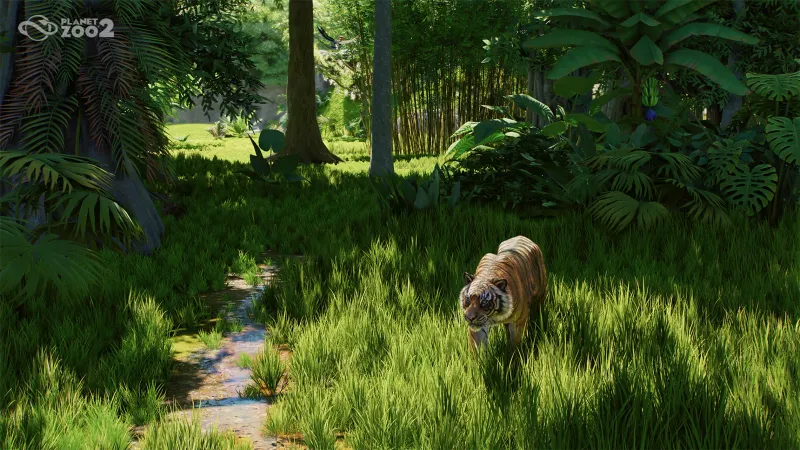
Check relationships before mixing species
Do not decide compatibility from diet or real-world behavior alone. Open each species’ Zoopedia entry and compare its Thriving relationships and Neutral relationships. Frontier’s current Animals guide treats these as distinct relationship categories, while the Red Deer Zoopedia page is a useful example of species-level data: it lists no species under thriving relationships and six under neutral relationships. Read the entries for every species in the proposed group; one pair’s result does not establish that the whole group will thrive.
Frontier also says animals of the same parents become Bonded by default and that Bonded animals never fight one another, overriding outsider relationships. Unrelated animals may become Bonded after spending time interacting in the same habitat. Treat Bonding as a specific relationship rule, not a guarantee that every mixed habitat is safe or meets each animal’s needs.
What predation means in Wildlife Reserves
Frontier identifies predators as one of the roles animals can fill in Wildlife Reserve ecosystems and says a suitable population across ecosystem roles contributes to biodiversity and reserve rating. Its Animals guide also lists predation among possible causes of sudden animal death. So predation is part of the game’s animal-survival context, but these passages do not provide a universal table saying which predator will hunt which other species, or when. Do not assume every predator automatically attacks every animal it can share a reserve with.
For a specific pair, use the current in-game Zoopedia and habitat information for both species. If the entries do not make the interaction clear, start with a low-risk habitat or reserve and observe the animals before moving a valuable group. A creator walkthrough can help locate the relationship panel, but use the game’s current entry for the species-specific decision.
Herding and deer antlers
Frontier describes the Animal Brain as producing more natural behavior, including animals herding together, grazing, and reacting to their surroundings. That confirms herding behavior is part of the simulation; it does not mean every species forms a herd or shares the same social rules. Check the specific species entry.
For Red Deer, Frontier’s Zoopedia describes males as larger and having multi-pronged antlers. It also says size varies with location and environmental conditions. The reviewed entry does not establish that an individual deer’s antlers grow, change shape, or vary over time in a particular way. Use the current species page for confirmed traits and avoid treating real-world variation as proof of a specific in-game mechanic.
Quick check before you build
- Open the Zoopedia entry for every species you plan to house together.
- Compare their thriving and neutral relationship lists; check welfare and habitat requirements separately.
- For a Wildlife Reserve, account for the ecosystem roles and population goals shown in the current reserve panel.
- If the predator/prey interaction is not stated for that species, test cautiously and monitor the animals rather than assuming a universal rule.
- 01
Open each Zoopedia entry
Review the species relationship categories.
- 02
Compare the whole group
Check every proposed pairing; one compatible pair does not prove the group is compatible.
- 03
Confirm in game
Review current behavior and warnings after introducing animals.
Related guides
Sources
- [1]Animals — Player Guide — Frontier Developments
Official current guide covering animal welfare, relationships, Bonding, and behavior.
- [2]Creature Feature: The Animal Brain — Frontier Developments
Official overview of animal behavior systems.
- [3]Creature Feature: Wildlife Reserves — Frontier Developments
Official guide to ecosystem roles in Wildlife Reserves.
- [4]Red Deer — Zoopedia — Frontier Developments
Species-specific example of the listed thriving and neutral relationship categories.
Was this helpful?
Thanks for the feedback!